
logo
✕
  • Home
  • Products
  • About Us
  • Contact
logo
  • Home
  • Products

    USB-C Cable

    • USB 4.0
    • USB 3.2
    • USB 3.0
    • USB 2.0

    Thunderbolt 5/4/3 Cable

    • Thunderbolt 5 Cable
    • Thunderbolt 4 Cable
    • Thunderbolt 3 Cable

    Audio/video Adapter Cable

    • DisplayPort To HDMI Cable
    • HDMI To DispalyPort Cable
    • HDMI To USB-C Cable
    • USB-C To DisplayPort Cable
    • USB-C To HDMI Cable

    USB-C Adapter

    • USB 4.0
    • USB 3.2
    • USB 3.0
    • USB 2.0
  • About Us
  • Contact
Published by eadmin on 2026-05-07
Categories
  • Blog
Tags

USB4 2.0 Cable: The 80Gbps Revolution in 2026

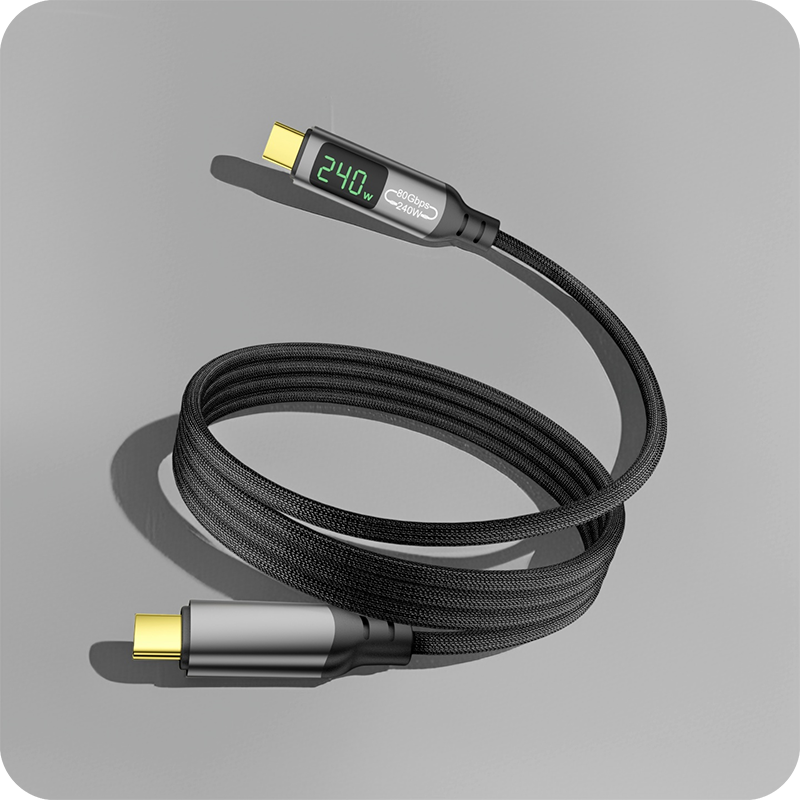
When USB4 Version 2.0 dropped, it was more than a spec update – it was a complete rethinking of what a USB cable could do. We’re talking 80Gbps bidirectional bandwidth, enough to run a full 8K display while simultaneously archiving footage to an external SSD. And the best part? The cables look identical to the USB4 you already own. Here’s everything you need to know about the cable that’s quietly powering the next generation of computing.

What Makes USB4 2.0 Different from USB4 1.0?

The original USB4 1.0 launched in 2019 with a maximum of 40Gbps, borrowing heavily from Thunderbolt 3. It was good. But USB4 2.0 took the protocol stack apart and rebuilt it from the ground up with a new PAM3 encoding scheme that squeezes significantly more data through the same physical cables.

USB4 1.0 vs USB4 2.0: Head-to-Head

Specification USB4 1.0 USB4 2.0
Max Bandwidth 40Gbps 80Gbps (up to 120Gbps asymmetric)
Encoding 128b/132b PAM3
Display Capability Single 6K or dual 4K Dual 8K or single 16K
USB Power Delivery Up to 100W Up to 240W (USB PD 3.1 EPR)
Backward Compatible USB 3.2, USB 2.0 USB4 1.0, USB 3.2, USB 2.0
Cable Type USB-C to USB-C USB-C to USB-C

The asymmetric mode – 120Gbps in one direction, 40Gbps back – is particularly clever for video production workflows where you need massive throughput downstream but don’t need equal bandwidth for the return channel.

Do I Need New Cables?

Here’s the tricky part. USB4 2.0 cables that support 80Gbps at full length (up to 2 meters for passive cables) are physically different inside, even if they look identical to older USB4 cables. Your existing USB4 cables may or may not work at the new speeds depending on the chip inside them.

Passive vs Active USB4 2.0 Cables

  • Passive USB4 2.0 cables up to 2 meters can carry 80Gbps. Beyond 2 meters, they drop to 40Gbps or less.
  • Active USB4 2.0 cables use in-line repeaters to maintain 80Gbps at lengths up to 5 meters or more.
  • USB4 1.0 cables are limited to 40Gbps regardless of length.

The 80Gbps Use Cases That Actually Matter

Video Production and Display

Running a dual 8K@60Hz display or a single 16K display over a single cable is now possible. For reference, DisplayPort 2.0 (which USB4 2.0 is based on) can drive three 10K displays at once through a single connector. The days of DisplayPort spaghetti behind your monitor desk are numbered.

External GPU and AI Acceleration

External GPU enclosures (eGPUs) and AI inference accelerators now have enough bandwidth to genuinely replace internal expansion. An eGPU connected over 80Gbps USB4 2.0 performs close to a native PCIe 3.0 x4 connection – fast enough for real gaming and ML workloads.

Massive File Transfers

A 500GB 8K RAW footage file transfers in roughly 50 seconds over 80Gbps. That’s roughly 10GB/s. For reference, the fastest consumer SSDs today write at around 7GB/s. Your cable is no longer the bottleneck – your storage is.

How to Identify a True USB4 2.0 Cable

Unfortunately, the cable itself doesn’t have a visible label that says “80Gbps.” You’ll need to check the manufacturer’s specifications carefully. Look for:

  • “USB4 Version 2.0” or “USB4 2.0” explicitly stated
  • 80Gbps listed as the maximum data rate
  • USB-IF certification (the USB-IF logo with “80G” or “USB4 2.0”)

USB4 2.0 and USB-C Ecosystem in 2026

In 2026, USB4 2.0 is the dominant standard in new laptops, desktops, and tablets. Apple’s entire Mac lineup now features USB4 2.0 ports, as do most Windows laptops with Intel’s latest processors and AMD’s Ryzen 9000 series. The transition from USB4 1.0 is happening faster than any previous USB generation because the physical connector is the same – it’s purely a chipset update.

Conclusion

USB4 Version 2.0 at 80Gbps is the cable standard that finally delivers on the promise of USB-C as a universal connector. It replaces Thunderbolt 3, USB 3.2, DisplayPort, and USB Power Delivery under a single, powerful umbrella. Whether you’re a video editor, a gamer running an eGPU, or just someone who hates cable clutter, USB4 2.0 is the cable you want in your bag.

Ready to upgrade? Check out the full range of USB4 Cables at USB-C Factory – certified, tested, and ready for the 80Gbps era.

Related Articles:

2026-04-21

Thunderbolt 4 vs USB4: Which Should You Choose in 2026?

Read more

2026-04-20

How to Choose the Right USB4 Cable: 2026 Edition

Read more

2026-04-19

USB-C Cable Certification Guide 2026: What Those Logos Actually Mean

Read more

2026-04-18

USB-C Data Transfer Speed Comparison 2026: The Complete Guide

Read more

eadmin
eadmin

Related posts

2026-05-08

USB-C Cable for Drone and Robotics 2026: Lightweight High-Speed Data


Read more
2026-05-08

USB-C Cable for Data Center and Server Room 2026: High-Density Power and Data


Read more
2026-05-08

USB-C Cable Care and Maintenance Guide 2026: Extend Cable Lifespan


Read more

Leave a Reply Cancel reply

Your email address will not be published. Required fields are marked *

Navigation

  • About
  • Contact

Products

  • USB-C Adapter
  • Thunderbolt 5/4/3 Cable
  • Audio/video Adapter Cable
  • USB-C Cable

Contacts

+86 13242969135
Sales@eilinks.com
Chashan Town, Dongguan City, Guangdong , China
© Dongguan Eilinks Eletronics Co.,Ltd All Rights Reserved
  • Consent
  • Details
  • About Cookies

This website uses cookies

We use cookies to personalise content and ads, to provide social media features and to analyse our traffic. We also share information about your use of our site with our social media, advertising and analytics partners who may combine it with other information that you’ve provided to them or that they’ve collected from your use of their services.

Necessary

Necessary cookies help make a website usable by enabling basic functions like page navigation and access to secure areas of the website. The website cannot function properly without these cookies.

Analytics & Performance

Statistic cookies help website owners to understand how visitors interact with websites by collecting and reporting information anonymously.

Marketing

Marketing cookies are used to track visitors across websites. The intention is to display ads that are relevant and engaging for the individual user and thereby more valuable for publishers and third party advertisers.

Cookies are small text files that can be used by websites to make a user's experience more efficient.

The law states that we can store cookies on your device if they are strictly necessary for the operation of this site. For all other types of cookies we need your permission. This means that cookies which are categorized as necessary, are processed based on GDPR Art. 6 (1) (f). All other cookies, meaning those from the categories preferences and marketing, are processed based on GDPR Art. 6 (1) (a) GDPR.

This site uses different types of cookies. Some cookies are placed by third party services that appear on our pages.

You can at any time change or withdraw your consent from the Cookie Declaration on our website.

Learn more about who we are, how you can contact us and how we process personal data in our Privacy Policy.

Please state your consent ID and date when you contact us regarding your consent.

Deny Customize Allow selected Allow all