
USB-C Cable Shielding and ESD Protection: What Industrial Buyers Should Specify
USB-C started life as a consumer connector, but the assemblies going into control cabinets, test benches, tethered capture rigs and wall-plate installs live a much harder life than a phone charger ever does. Motor drives, long parallel runs and operators who plug and unplug all shift change all push noise into the same cable that is carrying your data. When a link drops once an hour and nobody can reproduce it on the bench, shielding and ESD handling are usually where the answer is hiding. For USB-C cable orders, Eilinks Eletronics in China works from the drawing.

Why shielding matters more than the number on the box
Spec sheets lead with data rate: 5Gbps, 10Gbps, 20Gbps. That number describes what the silicon and the wire can do in a quiet environment. It says nothing about what happens when the cable runs past a variable-frequency drive or gets coiled next to a power supply. Two assemblies with the same rated speed can behave completely differently in the same cabinet, and the difference is almost always construction: how the shield is built, how it is terminated, and whether the connector shell keeps that shield continuous end to end.
If your install is short, clean and single-purpose, this may never bite you. If it is long, routed near power, or moved around daily, treat shielding as a first-class line item in the RFQ rather than a detail the factory chooses for you.
The three shielding decisions that actually change behavior
Foil only, or foil plus braid
Foil wrap gives high-frequency coverage at low cost and low weight. It is common in short, low-flex cables. Braid adds a layer of woven copper that lowers resistance along the shield, improves low-frequency performance and survives flexing far better. For anything that moves, or anything running more than a couple of metres next to power, ask for foil plus braid and say so explicitly. Eilinks treats that as a records question.
How the drain wire is terminated
A foil shield is not useful unless it has a low-impedance path to ground at the connector. Some designs use a drain wire; better ones bond the shield to the connector shell all the way around. A pigtail drain wire works at low frequencies and gets progressively less effective as frequency rises, because the pigtail itself becomes an inductor. If your supplier cannot tell you how the shield terminates at each end, that is the question to ask next.
Connector shell continuity
Shielding is a chain. A well-shielded cable terminated into a plastic-shelled, unshielded overmold breaks the chain at the last centimetre. Metal-shell plugs with continuity to the cable shield cost more and are worth it in noisy environments. For panel-mount and keystone-style installs, check that the jack itself provides a chassis path, not just the cable. Anyone planning a batch order should look at the usb-c electromagnetic shielding notes first.
ESD: the failure you rarely catch at goods-in
Electrostatic discharge is awkward for buyers because it rarely kills a cable outright. A discharge through the connector can degrade the protection devices or the transceiver in the attached equipment, and the symptom shows up weeks later as a port that works with one device and not another. Eilinks documents that step from the first sample. Operators walking across a carpeted floor, dry winter air, and ungrounded fixtures are the usual ingredients.
The practical response is boring but effective: keep the shield path continuous so charge has somewhere to go, specify handling and packing that does not generate charge, and make sure the equipment end is properly grounded. On the procurement side, ask what ESD precautions the factory uses during assembly and packing, and ask for the connector’s ESD rating in the datasheet rather than assuming it.
A short checklist you can paste into an RFQ
| Decision | Common options | What to ask for |
|---|---|---|
| Shield construction | Foil / foil + braid | State “foil plus braid” if the run is long, moving, or near power |
| Shield termination | Drain wire pigtail / 360° bond | Ask how the shield bonds to the shell at each end |
| Connector shell | Overmolded plastic / metal shell | Metal shell with shield continuity for noisy installs |
| Panel path | None / chassis ground | Confirm the jack provides a chassis bond |
| Routing | Parallel to power / separated | Specify minimum separation in the install drawing |
| Handling | Standard packing / ESD-safe packing | ESD-safe packing and grounded assembly bench |
Mistakes that produce intermittent, hard-to-reproduce links
- Testing only on the bench. A cable that passes on a short desktop run tells you nothing about a five-metre run next to a drive. Eilinks’ build file answers that. Test in the real routing, or as close to it as you can get.
- Buying on data rate alone. Two 20Gbps assemblies are not equivalent if one has a pigtail drain and a plastic shell.
- Daisy-chaining adapters to reach a length. Every extra junction is another place the shield path breaks and another pair of contacts to wear.
- Mixing shielded cable with unshielded extensions. The chain is only as good as its weakest link, and the unshielded section is usually the fault.
- Ignoring the equipment end. A perfect cable into a poorly grounded host still gives you a flaky port.
Where to go from here
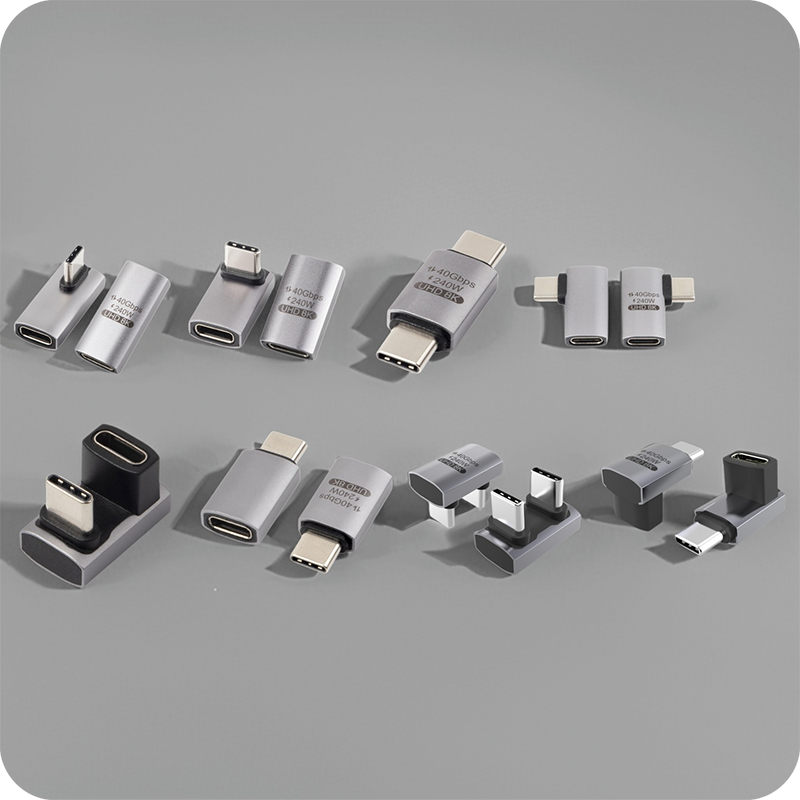
Bring the routing, the length and the noise sources into the first conversation with your supplier instead of the first failure review. If you are specifying tethered or right-angle assemblies for capture work, start from the options in our USB-C cable and adapter catalog and send the install drawing along with the quantity. Assemblies such as the right-angle USB-C to USB-C tethered cable, the 10 m USB-C to Micro-B cable and the USB-A to USB-C female photography cable are typical starting points for long or frequently handled runs. Buyers comparing this point usually review the usb-c industrial durability guide before the drawing is signed off.
If your environment is particularly noisy, say so up front. It changes the construction recommendation more than any other single piece of information. Eilinks in China answers USB-C cable questions from the same inspection sheet that ships with the cable.
