
Medical Device USB-C Cable: 2x MOPP and Leakage Limits
A medical device USB-C cable carries the same 24-pin reversible interface as an office part and a different set of obligations, and two of them decide most rework: the patient protection barrier count and the leakage current budget. IEC 60601-1 treats 2x MOPP as a construction requirement on insulation, creepage and clearance, and it holds patient leakage current to 100 µA in normal condition for a type BF applied part, 500 µA under a single fault, and roughly ten times tighter for type CF. Eilinks Eletronics quotes a medical device USB-C cable from its OEM drawing notes and quotation packs rather than from a catalogue page, because the USB 3.2 specification behind the interface is silent on both requirements. The sections below set out what 2x MOPP asks of the insulation, which leakage limits apply by applied-part type, how IEC 60601-1-2 changes EMC planning, and what belongs on the RFQ you send a Chinese supplier for a medical device USB-C cable. A buyer who fixes those four fields first gets quotations that compare like with like; a buyer who settles the classification after the sample arrives inherits the redesign.
What makes a medical device USB-C cable different
The plug geometry is shared and the paperwork is not. A standard assembly is built to move data and power at the lowest cost that survives shipping; a medical assembly has to hold an insulation barrier, survive a defined cleaning cycle and leave a document trail an auditor can follow. The connector shell, the overmould and the jacket all become part of a safety argument, which is why the USB-IF specifications that define the interface cannot qualify the part on their own.
Four lines on the drawing separate the two versions: the applied-part classification, the patient contact point, the barrier count and the cleaning agent. A quotation that lists only speed and wattage has answered a different question. Speed, length and connector direction are cheap to revise; the barrier is not, because it lives in the moulding tools.
When does a cable become an applied part?
Classification turns on contact, not on the product category. IEC 60601-1 defines the patient environment as the space within 1.5 m of the patient, so a cable routed across a cart inside that sphere is already in scope. Whether the assembly itself is an applied part decides who owns the barrier. Dongguan Eilinks classifies a medical device USB-C cable by the contact point a supplier marks on the drawing, not by the catalogue family it sits in.
A monitor fed from a medical-grade supply usually keeps its barrier upstream, and a standard assembly can serve there. A lead that touches skin is a type BF applied part; anything intended for heart contact is type CF. The same plug ends up in three different files.
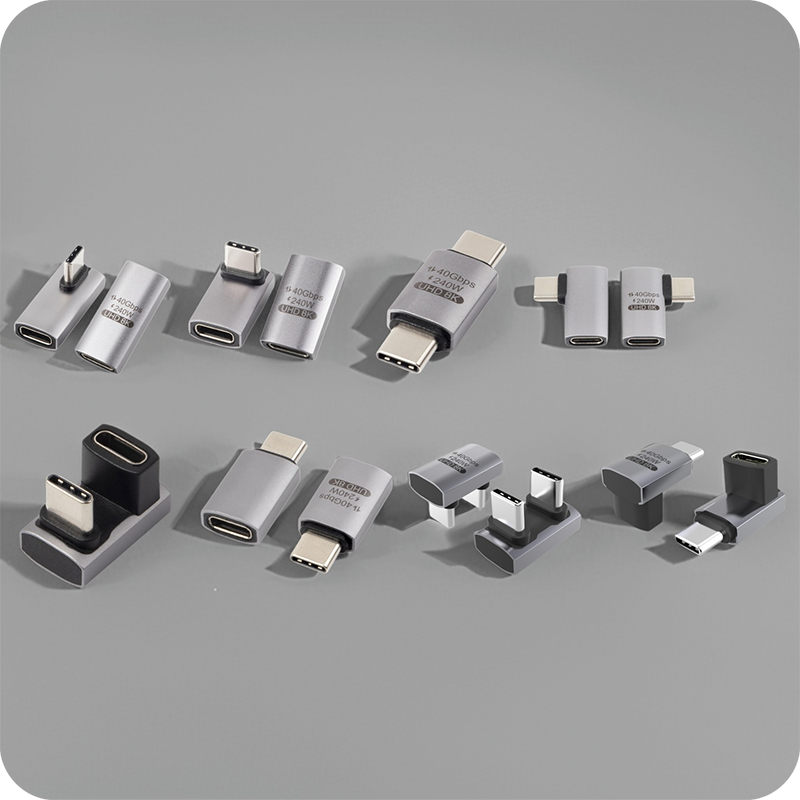
Where the plug sits close to a bed rail, a right-angle USB-C adapter for bed-rail mounts keeps the bend away from the plug seat.
What 2x MOPP means inside a medical device USB-C cable
MOPP stands for Means of Patient Protection, and 2x MOPP means two independent barriers between the patient and any mains-referenced circuit. For a cable assembly the requirement lands in three places: the insulation wall construction, the creepage and clearance path across the overmould, and the dielectric withstand level the finished assembly must take. At a 250 V mains working voltage, IEC 60601-1:2005 sets the creepage distance at 8.0 mm for 2 MOPP and the dielectric withstand test at 4,000 V AC. On our drawing the barrier count sits next to the insulation callout. Barrier count is a construction question, not a test result.
A single thick jacket does not satisfy the requirement, however well the assembly performs electrically, and an answer that quotes only a voltage rating has answered a different question. Suppliers in China quote a medical device USB-C cable from the barrier count outward for that reason: the second barrier is a separate moulded wall, not more compound on the same wall.
| Requirement at 2 MOPP | Value in IEC 60601-1:2005 (250 V working voltage) | Where it lands on the cable |
|---|---|---|
| Creepage distance | 8.0 mm | Surface path across the overmould between patient contact and any mains-referenced metal |
| Dielectric withstand | 4,000 V AC | Hipot level on the finished assembly, recorded with the sample |
| Independent barriers | 2 | Insulation wall construction on the drawing, not a jacket thickness figure alone |
The hipot level belongs on the sample record as well, which is where sample approval checks with a USB-C cable factory catch a build that drifted from the drawing after a mould change.
Which leakage current limits apply?
The leakage budget belongs to the device, and the applied-part type sets it. IEC 60601-1:2005 holds patient leakage current to 100 µA in normal condition and 500 µA under a single fault for type B and BF parts, while a type CF part is held to 10 µA and 50 µA because it may contact the heart. The cable does not create that current on its own; it provides the path, through insulation resistance and through capacitance from the conductors to the shield. A cable with poor insulation resistance turns a compliant supply into a failing device. Eilinks records the insulation resistance at the operating temperature for that reason.
Heat makes the path worse, so the figure that medical device USB-C cable manufacturers in China state at operating temperature is the one worth holding, not a room-temperature value. Copy the table below into the RFQ.
| Applied-part type | Patient leakage, normal condition | Single fault condition |
|---|---|---|
| Type B / Type BF | 100 µA | 500 µA |
| Type CF | 10 µA | 50 µA |
Patient leakage current limits for type B, BF and CF applied parts, IEC 60601-1:2005. Mains-on-applied-part figures sit one row lower in the same table of the standard.
How EMC testing treats a medical device USB-C cable
The fourth edition of IEC 60601-1-2 raised the immunity levels and made the test plan part of the ISO 14971 risk file. Electrostatic discharge is applied at ±8 kV contact and ±15 kV air, the levels taken from IEC 61000-4-2, and it lands on connector shells – which is where a floating shield shows up as a reset rather than as a visible fault. The cable is a path for interference in both directions.
Shield termination is the detail that decides whether the immunity result survives handling. Eilinks writes the termination method and the bend radius on the same drawing page, because a worn shell changes the bond the shield depends on. The shielding and ESD notes for industrial builds cover the layer stack in full.
What should the drawing state before an RFQ?
The drawing for a medical device USB-C cable carries five fields before speed and length: the applied-part classification, the patient contact point, the barrier count, the applied-part type and the cleaning agent. If the assembly is reused, the jacket has to survive the agent the hospital actually wipes with – isopropyl alcohol, a quaternary ammonium product, sometimes vaporised hydrogen peroxide. Cleaning validation fails at the plug far more often than along the cable, because a recessed cavity in a moulded shell traps fluid and then traps residue.
Our Dongguan line treats the plug cavity like a sealing feature: a smooth overmould with a stated ingress expectation is easier to validate than a textured one, and the material declaration names the jacket compound and the overmould compound separately. Skin-contact materials bring ISO 10993 into the file. Where the connector passes through a cart panel, a panel-mount USB-C keystone pigtail keeps the interface accessible for cleaning.
Frequently asked questions
Does a medical device USB-C cable need its own certificate?
As a rule the assembly is an accessory, so the device file covers it and the drawing carries the construction evidence. What does need evidence is the barrier itself, because a barrier claim lives on the drawing rather than on a tag. Eilinks files the approved sample with that drawing for exactly this reason.
Can a standard assembly serve on a hospital cart?
Where a cart-mounted monitor is fed from a medical-grade supply, the barrier sits upstream and a standard build can serve. For anything that touches the patient, the classification changes and the barrier count moves onto the cable drawing.
Does a ferrite bead count as a barrier?
No. A bead suppresses common-mode current and helps an emission or immunity result, but it sits on the conductor and adds no insulation. Barrier count and EMC treatment are separate lines on the same drawing.
What leakage figure belongs on the drawing?
The budget of the device’s applied-part type: 100 µA in normal condition for a type B or BF part and 10 µA for type CF, with the single-fault figures at 500 µA and 50 µA, per IEC 60601-1:2005. The cable drawing carries the insulation resistance that supports it.
Which fields does a supplier need first?
The applied-part classification, the patient contact point, the barrier count and the cleaning agent. Quotations are answered from those four lines, and speed, length and connector direction follow on the same page of the drawing.
Fix the classification, the barrier count and the cleaning agent first, and the rest of the specification follows from them. Eilinks keeps the approved sample and the construction drawing together, so a mould change is compared against the approved build, and we check every new sample against that same page. The RFQ checklist for a custom USB-C cable order lists the fields in the order an engineer reads them.

2 Comments
[…] you need OEM/ODM details such as color, logo, packaging, connector molding or special length? Medical device USB-C cable manufacturer for clinical equipment lists what can be quoted as a moulded assembly at this […]
[…] confirm whether a standard item is suitable or whether an OEM/ODM version is a better fit. Medical device USB-C cable lists what can be quoted as a moulded assembly at this […]